
Expert insight from Dr. Richard Cunningham, Orthopaedic Surgeon at Vail-Summit Orthopaedics & Neurosurgery
If you’ve been told you have knee arthritis, you may have heard about a newer cartilage restoration procedure called MACI (Matrix-Induced Autologous Chondrocyte Implantation). This innovative treatment can be life-changing for the right patient. However, it is not the answer for every patient with arthritis.
A question that Dr. Cunningham has been asked is: “What is MACI knee treatment, and can it help my arthritis?” The answer depends on the pattern and severity of your knee arthritis.
Quick Takeaways
- MACI is designed to treat isolated cartilage defects in the knee, not generalized “bone on bone” arthritis.
- Patients with early, localized cartilage injuries may be candidates for this cartilage restoration surgery.
- Advanced arthritis affecting multiple areas of the knee typically requires different treatment options.
- An evaluation by an experienced knee arthritis doctor near me can determine whether MACI is appropriate for your arthritic knee.
What Is MACI Knee Treatment?
Many patients ask, “What is MACI knee treatment?”
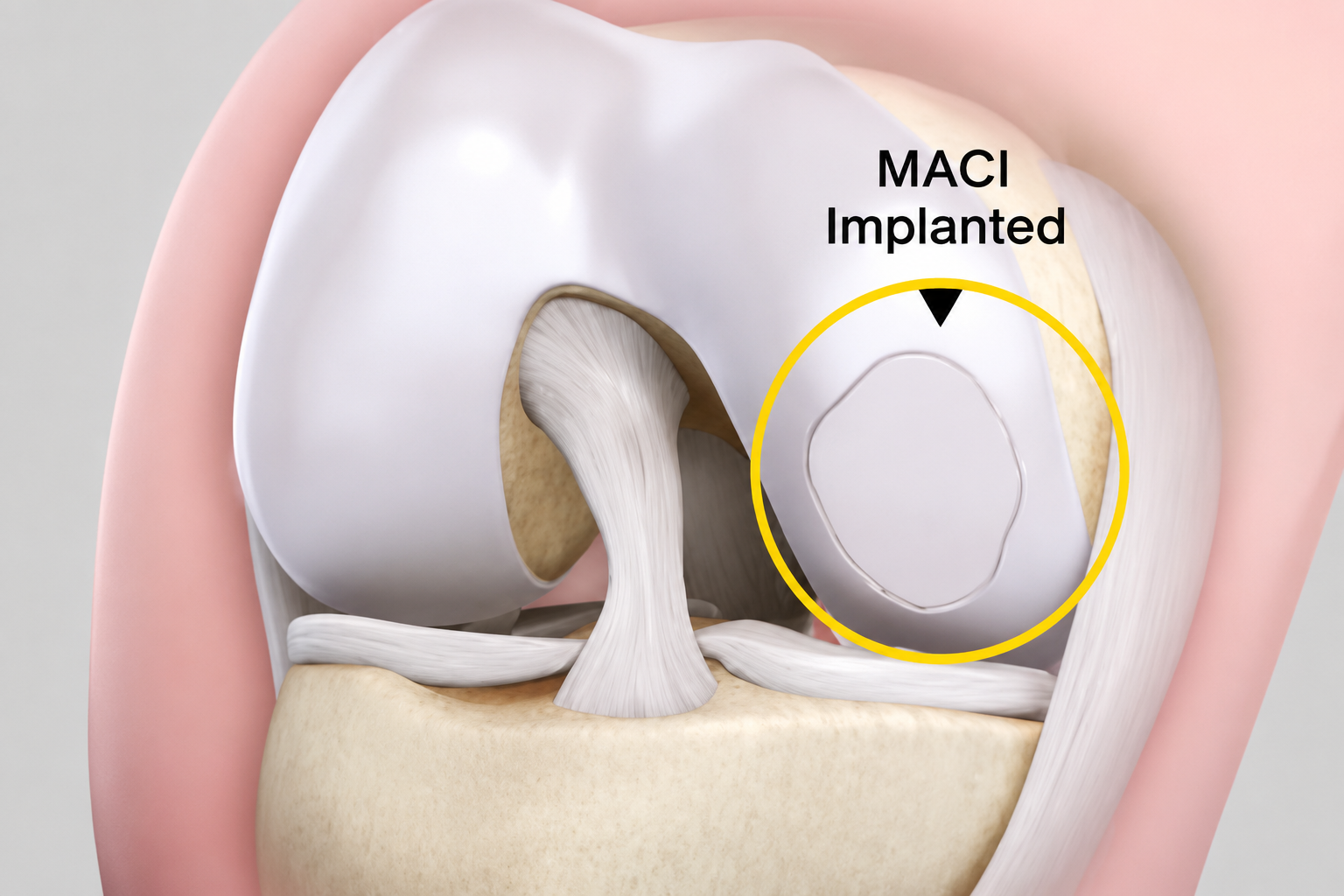
MACI (Matrix-Induced Autologous Chondrocyte Implantation) is an advanced cartilage restoration procedure that uses your own healthy cartilage cells which are multiplied in culture to repair areas of cartilage wear and loss within your knee.
“It’s one of the most effective treatments we have for restoring worn cartilage,” says Dr. Cunningham. “Rather than simply managing symptoms, MACI allows us to regenerate new cartilage in certain patients with knee arthritis.”
The procedure is performed in two stages. During the first arthroscopic surgery, Dr. Cunningham collects a small sample of healthy cartilage from a non-weight-bearing portion of your knee. These live cartilage cells are sent to the company’s laboratory, where they are isolated and then grown up in culture and multiplied over several weeks. These cells are then transplanted onto a porcine collagen membrane.
During the second procedure surgical procedure, the cartilage defect(s) in the knee is exposed, the edges of the defect precisely delineated, and then this collagen membrane imbedded with one’s cartilage cells are implanted into this defect and secured with a sort of human glue. Over time, the cells migrate and adhere to the bone, grow and mature, and ultimately form new articular cartilage. This technique is unique in that it is the only surgical technique that repairs a defect in one’s cartilage with your own cartilage cells. Moreover, unlike a microfracture procedure, the cartilage is not scar cartilage or fibrocartilage, but is comprised mostly of true articular cartilage cells which are the same type of cells that were once there.
Can MACI Treat Arthritis?
This is where the distinction becomes important.
Although MACI restores cartilage, it does not treat generalized knee arthritis.
“Many patients with arthritis have broad areas of worn cartilage which articulate against other areas of worn cartilage. Thus, the term ‘bone on bone.’ A patient with this type of arthritis is not a candidate for MACI.” Dr. Cunningham explains. “MACI is indicated for patients with one or more isolated areas of cartilage damage surrounded by otherwise healthy cartilage. In addition, in order to be a candidate for the procedure, the surface opposing the area of arthritis must have fairly normal cartilage. Bony alignment of the limb and the status of the stabilizing knee ligaments also have to be considered.”
Patients with widespread osteoarthritis with damage affecting the entire joint are not candidates for MACI. For these patients, other treatments, including injections, osteotomies, or partial or full knee replacement are utilized.
Who Is a Good Candidate?
Patients who benefit most from knee preservation surgery with MACI typically have:
- A single or unipolar area of cartilage damage on either the bottom end of the femur or the patella
- Healthy cartilage surrounding the area of cartilage damage
- Stable knee ligaments
- Good alignment of the knee (without bowed or knock-kneed alignment)
- A healthy weight and an active lifestyle with goals of returning to sports or recreation
“Younger, active patients with isolated cartilage injuries often make excellent candidates,” says Dr. Cunningham. “Our goal is to preserve and prolong the life of the natural knee whenever possible.”
Why Early Evaluation Matters
Cartilage injuries rarely heal on their own. Left untreated, a small defect can enlarge over time and eventually lead to severe, widespread arthritis. Seeing an experienced knee arthritis doctor near me early allows the problem to be diagnosed before more extensive joint damage develops.
Advanced imaging and a thorough examination help determine whether cartilage restoration, including MACI, is appropriate or whether other treatments will provide the best outcome.
Preserving Your Knee for the Future
For the right patient, cartilage knee restoration surgery can delay or even prevent the need for knee replacement while allowing patients to stay active.
“If we can restore healthy cartilage before arthritis becomes widespread, we have an opportunity to alleviate symptoms and extend the life of one’s native knee,” says Dr. Cunningham.
If you’re wondering if you are a candidate for MACI knee treatment, or you’ve been searching for a trusted knee arthritis doctor near me to evaluate your knee pain, Dr. Cunningham can determine whether knee cartilage preservation surgery is the right solution for you. Early diagnosis is the first step in preserving your natural joint and keeping you active for years to come. Contact Dr. Cunningham and his team today!